

Research
The ComBaCaL project aims at developing and assessing sustainable chronic care delivery models based on the latest scientific evidence and extensive community input to enhance access to essential health services in rural Lesotho. The ComBaCaL model of care combines the decentralization of essential chronic disease services through the involvement of Communiy Health Workers (CHWs) and the use of innovative digital health solutions.
ComBaCaL conducts its research activities in the districts of Butha-Buthe and Mokhotlong, Lesotho. In 2021, a disease prevalence survey involving over 6,000 participants was conducted. In 2022, the ComBaCaL pilot cohort was established in 10 villages, aimed at preparing for a larger main cohort and serving as a platform to test innovative CHW-led service delivery strategies. In 2023, the ComBaCaL main cohort was established in 103 rural villages with the objectives of assessing the evolving chronic disease burden and evaluating the effectiveness and implementation of CHW-led health service delivery strategies.
The ComBaCaL Main Cohort
The ComBaCaL main cohort consists of more than 14,000 consenting inhabitants of 103 randomly selected rural villages in the districts of Butha-Buthe and Mokhotlong, Lesotho. In each cohort village, one CHW equipped with a tablet loaded with a tailored clinical decision support and data collection application prospectively collects data on chronic disease risk factors and complications. The ComBaCaL main cohort uses the Trial within Cohorts (TwiCs) design that allows for the efficient implementation of multiple randomized trials within the cohort.
Baseline characteristics of the cohort were published in a cohort profile. Overall, the cohort consists of a population with low socioeconomic status, limited levels of formal education and insufficient access to clean toilets, energy, and water, posing multiple health risks. Significant prevalences of arterial hypertension (aHT), type 2 diabetes mellitus (T2D), and HIV were observed.
Currently, three TwiCs are evaluating the effectiveness of community-based aHT and T2D care delivered by CHWs.

Community-based hypertension care in rural Lesotho: evidence from two randomized trials
Within the ComBaCaL project, two pragmatic cluster-randomized trials evaluated whether lay community health workers (CHWs), supported by a digital clinical decision support system and embedded in the routine health system, can safely and effectively deliver community-based hypertension care.
The first trial focused on adults with uncontrolled hypertension at baseline. In this superiority trial, CHWs independently initiated and titrated antihypertensive medication according to national guidelines, supported by a tablet-based decision support application. Compared with routine facility-based care, community-based CHW-led care significantly increased the proportion of participants achieving blood pressure control at 12 months, improved engagement and linkage to care, and showed no relevant safety concerns. See the findings here.
The second trial addressed a complementary question by enrolling adults with controlled hypertension at baseline. This non-inferiority trial assessed whether community-based CHW-led care could maintain blood pressure control over 12 months as safely and effectively as routine facility-based care. Blood pressure control at 12 months was comparable between the two care models, meeting the prespecified non-inferiority criterion.
Taken together, these trials provide evidence that algorithm-guided task-sharing to lay community health workers can support hypertension treatment initiation, intensification, and maintenance under close to real-world conditions. The primary 12-months analyses of both trials are completed. A protocol amendment allows extended follow-up for up to 48 months, which will enable evaluation of longer-term care trajectories and sustainability of community-based hypertension management. Cost-effectiveness analyses of the trials are ongoing.
Community-based type 2 diabetes care in rural Lesotho
A pragmatic cluster-randomized trial within the ComBaCaL project evaluated whether lay CHWs, supported by digital decision tools and embedded in the routine health system, can deliver first-line type 2 diabetes care at community level.
Non-pregnant adults with type 2 diabetes identified through population-based screening were enrolled. In intervention villages, CHWs provided community-based diabetes care including lifestyle counselling and initiation and monitoring of first-line oral antidiabetic treatment; in control villages, participants were referred to routine facility-based care.
Among adults with uncomplicated, uncontrolled type 2 diabetes at baseline, the intervention showed a trend towards lower glycated haemoglobin (HbA1c) levels at 12 months, alongside higher engagement in care and no relevant safety concerns. See the findings here.
Overall, these findings suggest that CHWs, supported by digital decision tools, may be able to safely deliver first-line diabetes care in rural, resource-constrained settings.
Community-based HIV prevention in rural Lesotho
A nested randomized controlled trial planned for 2026 will evaluate the effectiveness and implementation of a Community-based, CHW-led, CDSS-assisted integrated HIV Prevention service delivery model in rural Lesotho (CoPrev model). In intervention villages, CHWs will conduct community-based HIV testing and deliver a comprehensive HIV prevention and contraception package. Among individuals at high risk of acquiring HIV, CHWs will offer HIV Post-Exposure Prophylaxis or Pre-Exposure Prophylaxis, as well as refills for oral contraception and self-injectable contraception to eligible participants. In contrast, CHWs in control villages will provide only community‑based HIV testing and refer individuals to facility-based services for biomedical HIV prevention and contraception. We hypothesize that the CoPrev model will effectively increase the proportion of time participants are covered by a biomedical HIV prevention method.
The ComBaCaL Pilot Cohort
aHT and T2D Pilot TwiCs
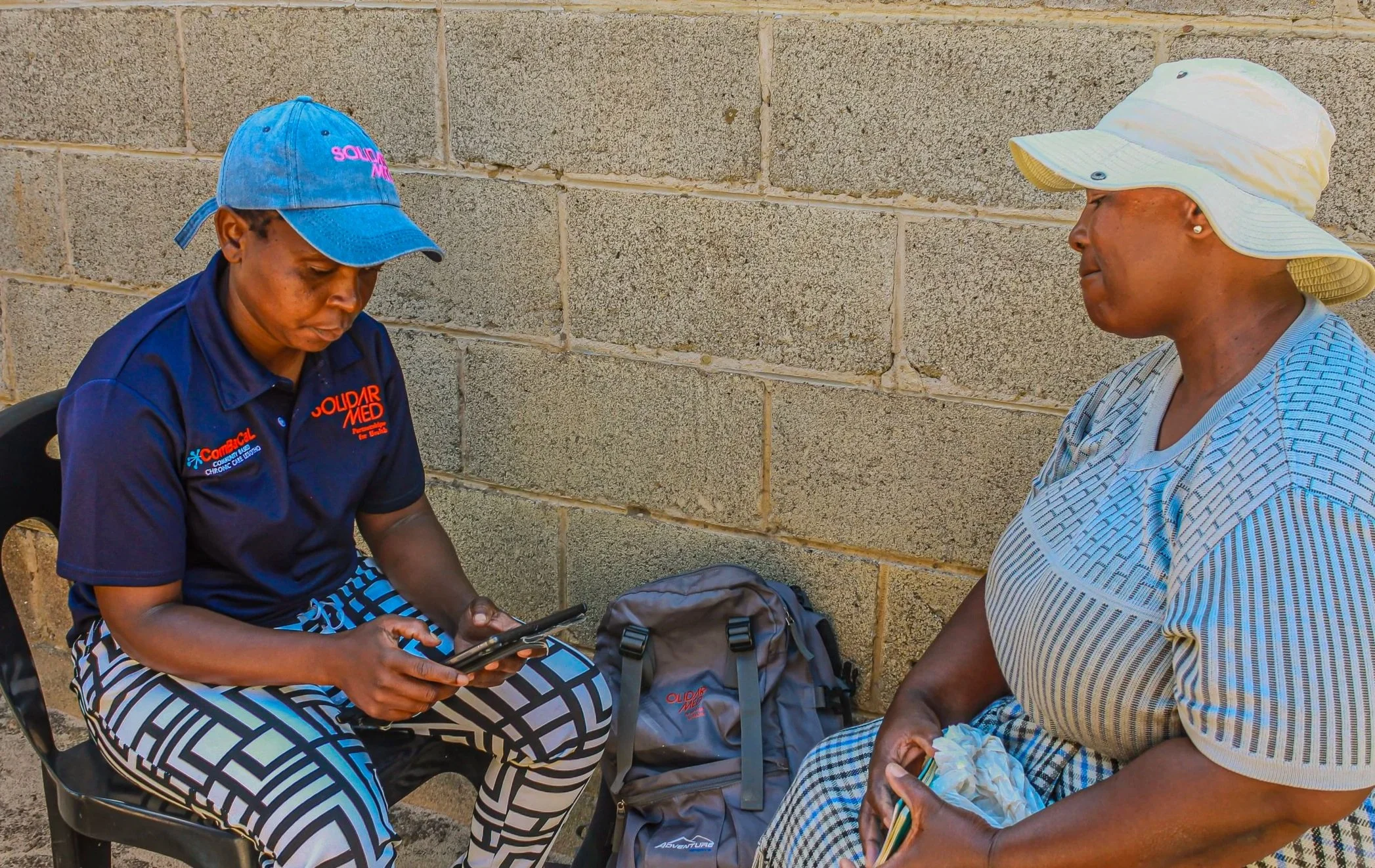
Two pilot TwiCs assessed the feasibility, acceptability and potential effectiveness of CHW-led management of aHT and T2D. The pilot TwiCs also sought to ascertain whether CHWs are able to cope with the additional workload with minimal supervision. Based on the learnings and preliminary data from these pilot studies, the service delivery models were refined for evaluation in the TwiCs in the main cohort.
Digital Health
The pilot cohort was the first group to become trained on the clinical decision support application that was developed to enable CHWs to deliver healthcare services that are traditionally provided by healthcare professionals, such as the prescription of basic antidiabetic and antihypertensive treatment. The clinical decision support application is based on the open-source Community Health Toolkit that enables the implementation of flexible workflows for community-based healthcare delivery offering essential features such as offline-first functionalities, automated task triggering and real-time remote monitoring. First experiences of using the app in our pilot cohort showed that it is perceived as useful and appropriate by the CHWs and empowers them in their daily work in the communities. Based on the experiences of using the ComBaCaL app in the pilot cohort, it was further refined to its current version used in the main cohort.
Co-IntegraL Pilot Study (Integrated Care)
A single-arm pre-post pilot study assesses the feasibility of a Community-based, CDSS-assisted, CHW-led, Integrated comprehensive service delivery model in rural Lesotho (Co-IntegraL model). CHWs will offer services for non-communicable disease management, sexual and reproductive health, HIV prevention and care, as well as child health. As a subcomponent of the study, CHWs will offer the Dapivirine Vaginal Ring (a biomedical HIV prevention method) to participants at risk of HIV acquisition as an additional prevention option, with the aim of assessing the acceptability community-level provision of this product. The study commenced in November 2025 and will continue through October 2026.
The ComBaCaL pilot cohort includes over 1,800 consenting participants from 10 villages and informed the design and implementation of the ComBaCaL main cohort. Within this cohort, two pilot TwiCs assessed the feasibility, acceptability, and potential effectiveness of CHW-led aHT and T2D management. These TwiCs also evaluated experiences with eHealth tools used in the interventions. Additionally, another nested study will pilot a CHW-led HIV prevention initiative.
We conducted a large population-based household survey on non-communicable chronic diseases in two districts in northeastern Lesotho.
NCD Prevalence Survey
